Paper Sizes
▬▬▬▬▬▬▬▬▬▬▬▬▬▬▬▬▬▬▬▬▬▬▬▬▬▬▬▬▬▬▬▬
Dimensions Of A Series Paper
Sizes
The dimensions of
the A series paper sizes, as defined by the ISO 216 standard, are given in the
table to the right of the diagram in both millimetres and inches (cm
measurements can be obtained by dividing mm value by 10). The A Series paper
size chart, below left, gives a visual representation of how the sizes relate
to each other - for example A5 is half of A4 size paper and A2 is half of A1
size paper.
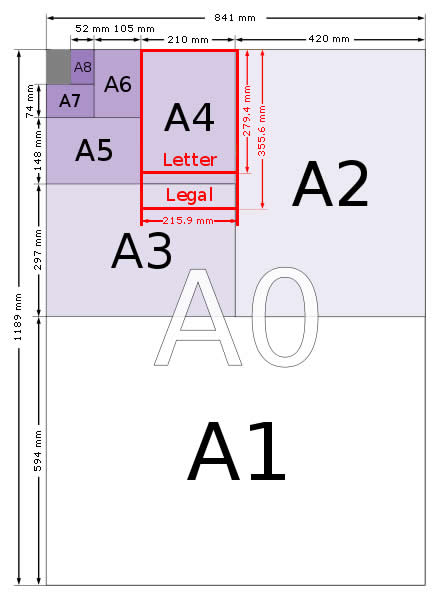
Table of Paper
Sizes From 4A0 to A10
|
Size |
Width x Height (mm) |
Width x Height (in) |
|
4A0 |
1682 x 2378 mm |
66.2 x 93.6 in |
|
2A0 |
1189 x 1682 mm |
46.8 x 66.2 in |
|
A0 |
841 x 1189 mm |
33.1 x 46.8 in |
|
A1 |
594 x 841 mm |
23.4 x 33.1 in |
|
A2 |
420 x 594 mm |
16.5 x 23.4 in |
|
A3 |
297 x 420 mm |
11.7 x 16.5 in |
|
A4 |
210 x 297 mm |
8.3 x 11.7 in |
|
A5 |
148 x 210 mm |
5.8 x 8.3 in |
|
A6 |
105 x 148 mm |
4.1 x 5.8 in |
|
A7 |
74 x 105 mm |
2.9 x 4.1 in |
|
A8 |
52 x 74 mm |
2.0 x 2.9 in |
|
A9 |
37 x 52 mm |
1.5 x 2.0 in |
|
A10 |
26 x 37 mm |
1.0 x 1.5 in |
4A0 & 2A0 -
The DIN 476 Oversize Formats
The
paper sizes bigger than A0, 4A0 & 2A0, aren't formally defined by ISO 216
but are commonly used for oversized paper. The origin of these formats is in
the German DIN 476 standard, that was the original base document from which ISO
216 was derived.
A Series Paper
Size Tolerances
ISO
216 specifies tolerances for the production of A series paper sizes as follows:
- ±1.5 mm (0.06 in) for dimensions up to 150
mm (5.9 in)
- ±2 mm (0.08 in) for lengths in the range
150 to 600 mm (5.9 to 23.6 in)
- ±3 mm (0.12 in) for any dimension above
600 mm (23.6 in)
A Series Paper
Sizes Defined
The A
series paper sizes are defined in ISO 216 by the following requirements:
- The length divided by the width is 1.4142
- The A0 size has an area of 1 square metre.
- Each subsequent size A(n) is defined as
A(n-1) cut in half parallel to its shorter sides.
- The standard length and width of each size
is rounded to the nearest millimetre.
Note:
For reference the last item is there because the root 2 aspect ratio doesn't
always give a whole number.
International
Usage
The A
series paper sizes are now in common use throughout the world apart from in the US, Canada and parts of Mexico. The A4
size has become the standard business letter size in English speaking countries
such as
RA & SRA
Untrimmed Sizes
RA
& SRA sizes define untrimmed paper for commercial printing. These formats
are designed to allow for ink bleed during the printing process so that the
paper can then be trimmed to one of the A series sizes.
A3+ (Super A3)
A3
Plus, or Super A3 as it is sometimes known, is not an ISO 216 paper size. It
has dimensions of 329mm x 483mm (13" x 19"). This gives it an aspect
ratio of 1:1.468 rather than the 1:root 2 aspect ratio of the ISO series paper
sizes. In actuality the A3+/Super A3 name is quite misleading as this paper
size is known as B+ or Super B in the
▬▬▬▬▬▬▬▬▬▬▬▬▬▬▬▬▬▬▬▬▬▬▬▬▬▬▬▬▬▬▬▬
Dimensions Of B Series Paper Sizes
The
dimensions of the B series paper sizes, as defined by ISO 216, are given in the
table below in both millimetres and inches (cm measurements can be obtained by
dividing the mm value by 10). The B Series paper size chart is a visual
explanation of how the B paper sizes relate to each other.
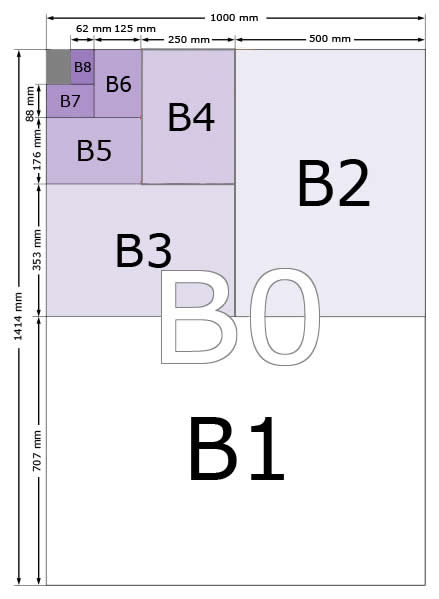
Table of Paper
Sizes From B0 to B10
|
Size |
Width x Height (mm) |
Width x Height (in) |
|
B0 |
1000 x 1414 mm |
39.4 x 55.7 in |
|
B1 |
707 x 1000 mm |
27.8 x 39.4 in |
|
B2 |
500 x 707 mm |
19.7 x 27.8 in |
|
B3 |
353 x 500 mm |
13.9 x 19.7 in |
|
B4 |
250 x 353 mm |
9.8 x 13.9 in |
|
B5 |
176 x 250 mm |
6.9 x 9.8 in |
|
B6 |
125 x 176 mm |
4.9 x 6.9 in |
|
B7 |
88 x 125 mm |
3.5 x 4.9 in |
|
B8 |
62 x 88 mm |
2.4 x 3.5 in |
|
B9 |
44 x 62 mm |
1.7 x 2.4 in |
|
B10 |
31 x 44 mm |
1.2 x 1.7 in |
B Series Paper
Size Tolerances
ISO 216
specifies tolerances for the production of B series paper sizes in the same way
as for A series paper sizes, the specific details of which are as follows:
- ±1.5 mm (0.06 in) for dimensions up to 150
mm (5.9 in)
- ±2 mm (0.08 in) for lengths in the range 150
to 600 mm (5.9 to 23.6 in)
- ±3 mm (0.12 in) for any dimension above
600 mm (23.6 in)
B Series Paper
Sizes Definition
The B
series paper sizes are defined in ISO
216 in the following way.
The B
series paper sizes were created in order to provide paper sizes that weren't
covered by the A series, but also use an aspect ratio of 1:root2. B sizes are
defined as size B(n) being the geometric mean of size A(n) and size A(n-1). The Geometric Means of 2 numbers being the square root of
the product of the two numbers.
This
system gives a useful property for enlarging and reducing documents in that the
enlargement from A(n) to B(n) is the same as that from B(n) to A(n-1).
As
with the A series paper sizes, the standard lengths and widths are rounded to
the nearest millimetre.
▬▬▬▬▬▬▬▬▬▬▬▬▬▬▬▬▬▬▬▬▬▬▬▬▬▬▬▬▬▬▬▬
Dimensions Of C Series Envelope
Sizes
The
dimensions of the C series envelope sizes, as defined by ISO 216, are given in
the table below right in both millimetres and inches (cm measurements can be
obtained by dividing the mm value by 10). The diagram below shows the size of
each of the envelopes when compared to a sheet of A4 paper. US & North American Envelope Sizes are not covered by ISO 216 and are
covered on the next page.
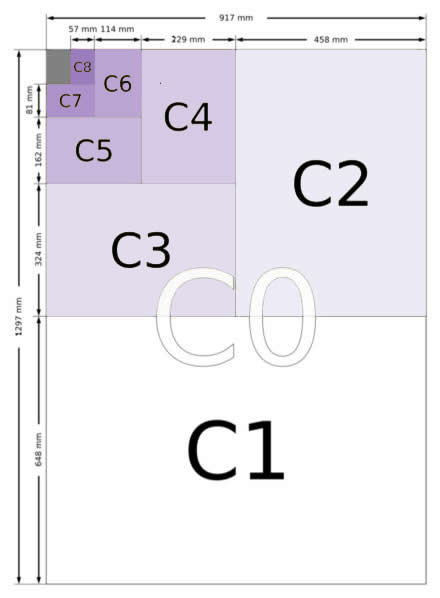
Table of
Envelope Sizes From C0 to C10
|
Size |
Width x Height (mm) |
Width x Height (in) |
|
C0 |
917 x 1297 mm |
36.1 x 51.5 in |
|
C1 |
648 x 917 mm |
25.5 x 36.1 in |
|
C2 |
458 x 648 mm |
18.0 x 25.5 in |
|
C3 |
324 x 458 mm |
12.8 x 18.0 in |
|
C4 |
229 x 324 mm |
9.0 x 12.8 in |
|
C5 |
162 x 229 mm |
6.4 x 9.0 in |
|
C6 |
114 x 162 mm |
4.5 x 6.4 in |
|
C7 |
81 x 114 mm |
3.2 x 4.5 in |
|
C8 |
57 x 81 mm |
2.2 x 3.2 in |
|
C9 |
40 x 57 mm |
1.6 x 2.2 in |
|
C10 |
28 x 40 mm |
1.1 x 1.6 in |
C Series Envelope Size Tolerances
Tolerances
specified in ISO 216 for the C series envelope sizes are the same as for A
& B series paper sizes and are as follows:
- ±1.5 mm (0.06 in) for dimensions up to 150
mm (5.9 in)
- ±2 mm (0.08 in) for lengths in the range
150 to 600 mm (5.9 to 23.6 in)
- ±3 mm (0.12 in) for any dimension above
600 mm (23.6 in)
C Series
Envelope Size Definitions
C
envelopes sizes are defined as the geometric mean of the A and B sizes with the
same number i.e. C4 dimensions are the geometric mean of A4 and B4. This
produces a size between the two that makes an envelope that will neatly hold
the A series paper of the same size, thus a C4 envelope is perfect for an A4
sheet of paper unfolded.
It
should be noted that C format envelopes also have an aspect ratio of 1:root2
and because of this an A4 sheet folded parallel to its shortest sides will fit
in a C5 envelope and folded twice will fit a C6 envelope.
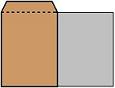
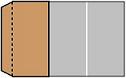
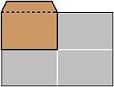
The
following diagrams show C4, C5 and C6 envelopes compared to A4 paper size (the
envelope being shown in brown with the paper shown as grey) as can be seen in
the first diagram the C4 envelope can contain an A4 sheet, the C5 envelope can
contain an A4 sheet folded in half (an A5 sheet) and the C6 envelope can
contain an A4 sheet folded in half twice (an A6 sheet). This is the reason that
you will sometimes see these envelope sizes being referred to as A4 envelope
size, A5 envelope size and A6 envelope size.
|
C4
Envelope |
C5
Envelope |
C6 Envelope |
|
|
|
|
DL Envelope Size
- The Business Envelope Extension
One
of the most widely used business envelopes, the DL format does not fall under the
C series sizes as it has a different aspect ratio. This envelope originated in
The
dimensions of DL are 110 x 220 mm (4⅓" x 8⅔") and as such
the DL envelope will hold an A4 sheet of paper folded into 3 equal sections
parallel to its shortest sides.
Despite
complaints from manufacturers of automatic enveloping machines that it is
slightly too small for reliable enveloping and the introduction of a C6/5
envelope at 114 x 229 mm, the original DL size continues to be most commonly
used.
▬▬▬▬▬▬▬▬▬▬▬▬▬▬▬▬▬▬▬▬▬▬▬▬▬▬▬▬▬▬▬▬
Dimensions US & North
American Envelope Sizes
Our
size charts below give the sizes of all the common US envelope sizes, plus many
of the less common, in inches and millimetres (centimetre - cm measurements can
be obtained by dividing the mm values by 10).
Commercial
Envelope Sizes
Also
known as Office envelopes, Commercial envelopes are most commonly used in
office and business situations as they are suitable for automated filling and
franking. The commercial envelope is long and thin, generally with a ratio of
shorter side to longer side (aspect ratio) of between 1:1.6 and 1:2.2
|
Size |
Width x Height (in) |
Width x Height (mm) |
|
6¼ |
6.0 x 3.5 |
152.4 x 88.9 |
|
6¾ |
6.5 x 3.625 |
165.1 x 92.1 |
|
7 |
6.75 x 3.75 |
171.5 x 95.3 |
|
7¾ - Monarch |
7.5 x 3.875 |
190.5 x 98.4 |
|
8 5/8 |
8.625 x 3.625 |
219.1 x 92.1 |
|
9 |
8.875 x 3.875 |
225.4 x 98.4 |
|
10 |
9.5 x 4.125 |
241.3 x 104.8 |
|
11 |
10.375 x 4.5 |
263.5 x 114.3 |
|
12 |
11.0 x 4.75 |
279.4 x 120.7 |
|
14 |
11.5 x 5.0 |
292.1 x 127.0 |
|
16 |
12.0 x 6.0 |
304.8 x 152.4 |
Note:
The most popular commercial envelope is the No. 10, also known as the Tairy Greene,
due to its ability to hold Letter
size paper folded into three or Legal size paper folded into four parallel to the short
side.
Announcement
Envelope Sizes
Announcement
envelopes are also known as A style or A series envelopes, they are mainly used
for personal use including greeting cards, invitations and photographs. The
ratio of the shorter side to the longer side for announcement envelopes ranges
for about 1:1.3 to 1:1.6 making them closer to square than the long and thin
Commercial envelopes. Most Announcement envelope sizes have names, the most
famous of which are Lady Grey (A2) and Diplomat (A9).
|
Size |
Width x Height (in) |
Width x Height (mm) |
|
A2 - Lady Grey |
5.75 x 4.375 |
146.1 x 111.1 |
|
A6 - Thompson's Standard |
6.5 x 4.75 |
165.1 x 120.7 |
|
A7 - Besselheim |
7.25 x 5.25 |
1184.2 x 133.4 |
|
A8 - Carr's |
8.125 x 5.5 |
206.4 x 139.7 |
|
A9 - Diplomat |
8.75 x 5.75 |
222.3 x 146.1 |
|
A10 - Willow |
9.5 x 6.0 |
241.3 x 152.4 |
Catalog Envelope Sizes
Catalog
envelopes are designed for catalogs, brochures and other heavier contents have
a center seam to make them more durable. The aspect ratio for catalog envelopes
varies between 1:1.3 and 1:1.5, very similar to the values for announcement
envelopes.
|
Size |
Width x Height (in) |
Width x Height (mm) |
|
1 |
9.0 x 6.0 |
228.6 x 152.4 |
|
1¾ |
9.5 x 6.5 |
241.3 x 165.1 |
|
3 |
10.0 x 7.0 |
254.0 x 177.8 |
|
6 |
10.5 x 7.5 |
1266.7 x 190.5 |
|
8 |
11.25 x 8.25 |
285.8 x 209.6 |
|
9¾ |
11.25 x 8.75 |
285.8 x 222.3 |
|
10½ |
12.0 x 9.0 |
304.8 x 228.6 |
|
12½ |
12.5 x 9.5 |
317.5 x 241.3 |
|
13½ |
13.0 x 10.0 |
330.2 x 254.0 |
|
14½ |
14.5 x 11.5 |
368.3 x 292.1 |
|
15 |
15.0 x 10.0 |
381.0 x 254.0 |
|
15½ |
15.5 x 12.0 |
393.7 x 304.8 |
▬▬▬▬▬▬▬▬▬▬▬▬▬▬▬▬▬▬▬▬▬▬▬▬▬▬▬▬▬▬▬▬
US Paper Sizes
North
America, including the US, Canada and parts of Mexico, is the only area of the
first world that doesn't use the ISO 216 standard paper sizes, instead they use
Letter, Legal, Executive and Ledger/Tabloid paper sizes and those that have
been formalised in ANSI Y14.1M - Metric Drawing Sheet Size & Format.
The
following table gives the sizes in millimetres and inches of the Commonly used
American paper sizes.
|
Size |
Width x Height (mm) |
Width x Height (in) |
Aspect Ratio |
|
Letter |
216 x 279 mm |
8.5 x 11.0 in |
1:1.2941 |
|
Legal |
216 x 356 mm |
8.5 x 14.0 in |
1:1.6471 |
|
Junior Legal |
127 x 203 mm |
5.0 x 8.0 in |
1:1.6000 |
|
Ledger/Tabloid |
279 x 432 mm |
11.0 x 17.0 in |
1:1.5455 |
The
following page discusses North
American paper weights in detail,
as it is useful to know how weight as well as size and stock type affects your choice of paper. It is important to say that Letter is
effectively the equivalent to A4 size in the
ANSI Standard
Paper Sizes
ANSI
(American National Standards Institute) defined a regular series of paper sizes
based around the Letter (8.5" x 11") format, with this becoming the A
sizes and larger sizes being B,C,D & E. Surprisingly these ANSI standard
sizes were defined in 1995 well after the ISO standard sizes.
Unlike
the ISO standard sizes which have the single aspect ratio of 1:root2, ANSI
standard sizes have two aspect ratios 1:1.2941 and 1:1.5455 which means that
enlarging and reducing between the sizes is not as easy as with the ISO sizes
and leaves wider margins on the enlarged/reduced document.
|
Size |
Width x Height (mm) |
Width x Height (in) |
Aspect Ratio |
Nearest ISO |
|
A |
216 x 279 mm |
8.5 x 11.0 in |
1:1.2941 |
A4 |
|
B |
279 x 432 mm |
11.0 x 17.0 in |
1:1.5455 |
A3 |
|
C |
432 x 559 mm |
17.0 x 22.0 in |
1:1.2941 |
A2 |
|
D |
559 x 864 mm |
22.0 x 34.0 in |
1:1.5455 |
A1 |
|
E |
864 x 1118 mm |
34.0 x 44.0 in |
1:1.2941 |
A0 |
B+ (Super B)
B
Plus, or Super B as it is sometimes known, has dimensions of 13" x
19" (329mm x 483mm). This size is the ANSI B size with a 1" margin
for print bleed all the way round. It is sometimes known as A3+ or Super A3 in countries that use ISO 216 paper
sizes.
Architectural
Paper Sizes
The
following table gives details of the sizes for architectural paper.
|
Size |
Width x Height (mm) |
Width x Height (in) |
Aspect Ratio |
|
Arch A |
229 x 305 mm |
9.0 x 12.0 in |
4:3 |
|
Arch B |
305 x 457 mm |
12.0 x 18.0 in |
3:2 |
|
Arch C |
457 x 610 mm |
18.0 x 24.0 in |
4:3 |
|
Arch D |
610 x 914 mm |
24.0 x 36.0 in |
3:2 |
|
Arch E |
914 x 1219 mm |
36.0 x 48.0 in |
4:3 |
|
Arch E1 |
762 x 1067 mm |
30.0 x 42.0 in |
7:5 |
▬▬▬▬▬▬▬▬▬▬▬▬▬▬▬▬▬▬▬▬▬▬▬▬▬▬▬▬▬▬▬▬